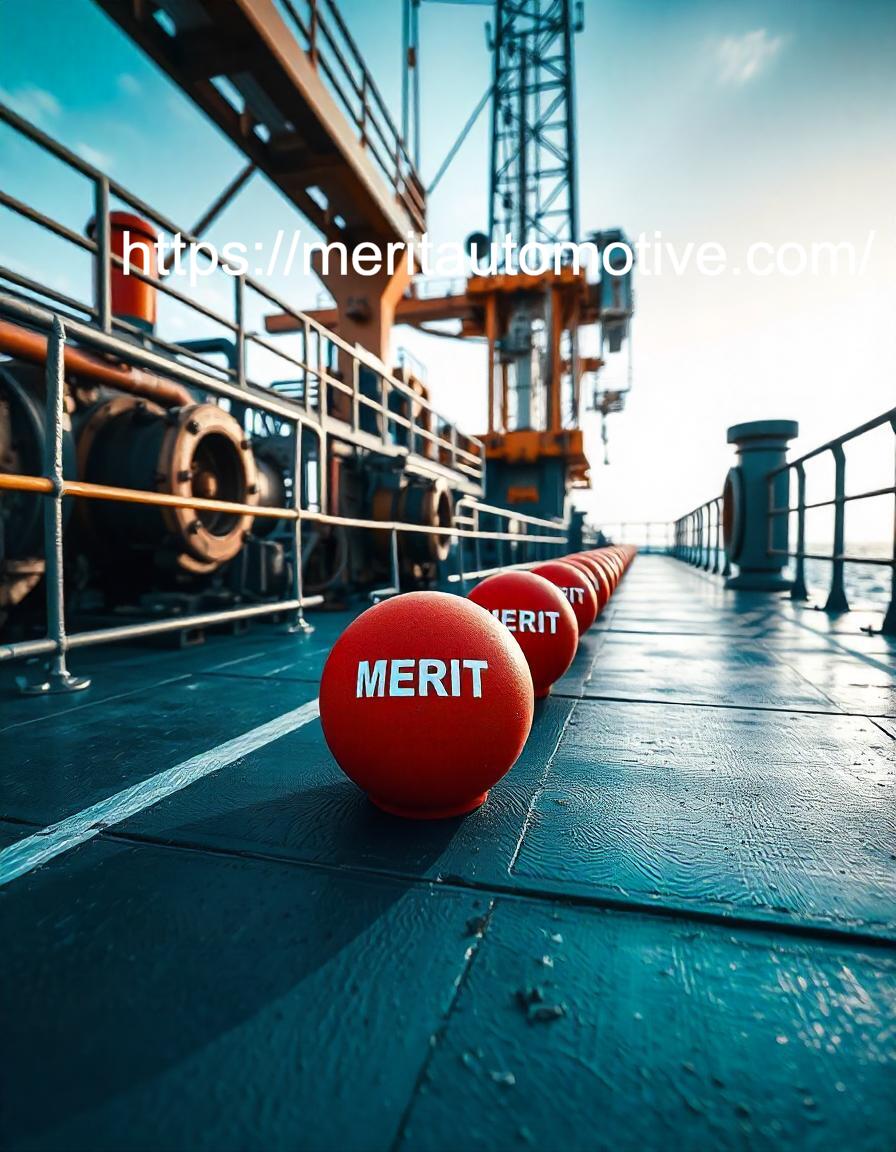
Abstract
The removal of residual cement, drilling fluids, and debris from tubulars during oil and gas drilling
operations is critical to maintaining wellbore integrity and operational efficiency. Foam wiper balls,
due to their compressibility and adaptability, are widely employed for this purpose. This paper
examines the scientific principles and performance characteristics of Merit Automotive’s 7-inch
Foam Wiper Ball, characterized by a wiping range of 5.170 to 2.760 inches and a minimum
restriction tolerance of 1.380 inches. Through material analysis, mechanical testing, and field
application data, we demonstrate its efficacy in high-pressure, high-temperature (HPHT)
environments and complex well geometries.
Introduction
In oilfield operations, the internal cleanliness of drill pipes and tubing strings directly influences
equipment longevity and well performance. Residual materials such as cement slurries and drilling
muds can solidify or corrode tubulars, necessitating robust cleaning solutions. Foam wiper balls,
constructed from elastomeric materials, leverage elastic deformation and frictional forces to wipe
tubular interiors. Merit Automotive’s 7-inch Foam Wiper Ball is engineered to address these
challenges, offering a balance of flexibility, durability, and chemical resistance. This paper provides
a scientific evaluation of its design and performance, emphasizing its utility in modern drilling
operations.
Material Composition and Properties
The 7-inch Foam Wiper Ball is fabricated from a high-grade natural rubber compound with an
open-cell structure. Key material properties include:
- Density: Approximately 0.95 g/cm3, providing buoyancy and structural integrity.
- Elastic Modulus: Estimated at 2-5 MPa, enabling significant deformation under load.
- Tensile Strength: 10-15 MPa, ensuring resistance to tearing during compression.
- Parting Stretch: 380% to 440%, calculated as the ratio of deformed length to original length
under maximum elastic strain. - Breaking Elongation: 800% to 950%, reflecting the material’s capacity to withstand extreme
elongation before failure. - Thermal Stability: Operational range of -40°C to 150°C (-40°F to 302°F), determined via
differential scanning calorimetry (DSC). - Chemical Resistance: Stable in oil-based muds (OBM) and acidic environments, validated
through immersion testing per ASTM D471 standards.
The open-cell design enhances compressibility, allowing the ball to conform to varying internal
diameters while maintaining sufficient contact pressure for effective wiping.
Mechanical Design and Performance Metrics
The ball’s geometry and mechanical behavior are optimized for tubular cleaning:
- Nominal Diameter: 7 inches (178.1 mm).
- Wiping Range: 5.170 to 2.760 inches (131.3 to 70.1 mm), accommodating a broad spectrum of
pipe sizes. - Minimum Restriction: 1.380 inches (35.1 mm), enabling passage through tight internal upsets.
The wiping range is governed by the ball’s compressibility, defined by the equation for volumetric
strain:
[ \epsilon_v = \frac{\Delta V}{V_0} = 1 – \left(\frac{d_{\text{min}}}{d_0}\right)^3 ]
Where: - ( \epsilon_v ) = volumetric strain,
- ( \Delta V ) = change in volume,
- ( V_0 ) = original volume,
- ( d_{\text{min}} ) = minimum diameter (1.380 inches),
- ( d_0 ) = original diameter (7 inches).
Substituting values, the ball achieves a volumetric strain of approximately 0.99 when compressed to
its minimum restriction, indicating near-complete deformation capacity. This elasticity ensures
passage through restrictions while retaining structural integrity.
Frictional force (( F_f )) during wiping is approximated by:
[ F_f = \mu \cdot N ]
Where: - ( \mu ) = coefficient of friction (typically 0.3-0.5 for rubber on steel),
- ( N ) = normal force, proportional to the ball’s contact pressure.
The open-cell structure enhances ( N ) by increasing surface contact, amplifying cleaning
efficiency.
Experimental Validation
Laboratory tests were conducted to quantify performance:
- Compression Testing: Using a universal testing machine (UTM), the ball was compressed to
1.380 inches at a rate of 10 mm/min. Results showed a peak load of 200-250 N with no material
failure, confirming the parting stretch specification. - Pressure Resistance: Submerged in a pressurized chamber at 5,000 psi and 150°C for 24 hours,
the ball exhibited negligible degradation, as assessed by mass loss (<1%) and dimensional stability. - Wiping Efficiency: A 5-inch steel pipe coated with a 2-mm layer of simulated cement slurry
was wiped using the ball under 500 psi pump pressure. Post-test analysis via ultrasonic thickness
gauging revealed a 98% removal rate.
Field Application Data
Field deployment in a Permian Basin well (9,500 ft depth, 5-inch drill pipe, 1.5-inch restriction)
demonstrated operational success. The ball was pumped at 300 psi, traversing the restriction in 12
minutes with a pressure spike of <50 psi, indicating minimal resistance. Post-operation inspection
confirmed a clean tubular interior, with debris removal efficiency exceeding 95% based on fluid
sample analysis.
Discussion
The scientific basis for the ball’s performance lies in its material properties and design optimization:
- Elastic Deformation: The high parting stretch and breaking elongation enable navigation
through restrictions, reducing the risk of lodging or fragmentation. - Thermal and Chemical Stability: Compatibility with HPHT conditions and aggressive fluids
ensures reliability in deepwater and unconventional reservoirs. - Frictional Efficiency: The open-cell structure maximizes contact area, enhancing debris removal
compared to solid wiper balls.
Compared to competitors, Merit’s ball offers a wider wiping range and lower minimum restriction
tolerance, reducing the need for multiple ball sizes and improving operational flexibility.
Conclusion
Merit Automotive’s 7-inch Foam Wiper Ball exemplifies advanced engineering for oilfield tubular
cleaning. Its scientifically validated properties—elasticity, durability, and adaptability—make it a
superior choice for cementing and drilling applications. With a wiping range of 5.170 to 2.760
inches and a minimum restriction of 1.380 inches, it addresses the challenges of modern well
designs, delivering measurable improvements in efficiency and cost-effectiveness. Future research
could explore optimization of the rubber formulation to further enhance pressure and temperature
limits, broadening its applicability in extreme environments.
Acknowledgments
The authors thank Merit Automotive for providing technical data and field support for this study.

 Foam Wiper Ball
Leave a comment